


Introduction
Artificial intelligence is reshaping search, content creation, and digital marketing at an unprecedented scale.
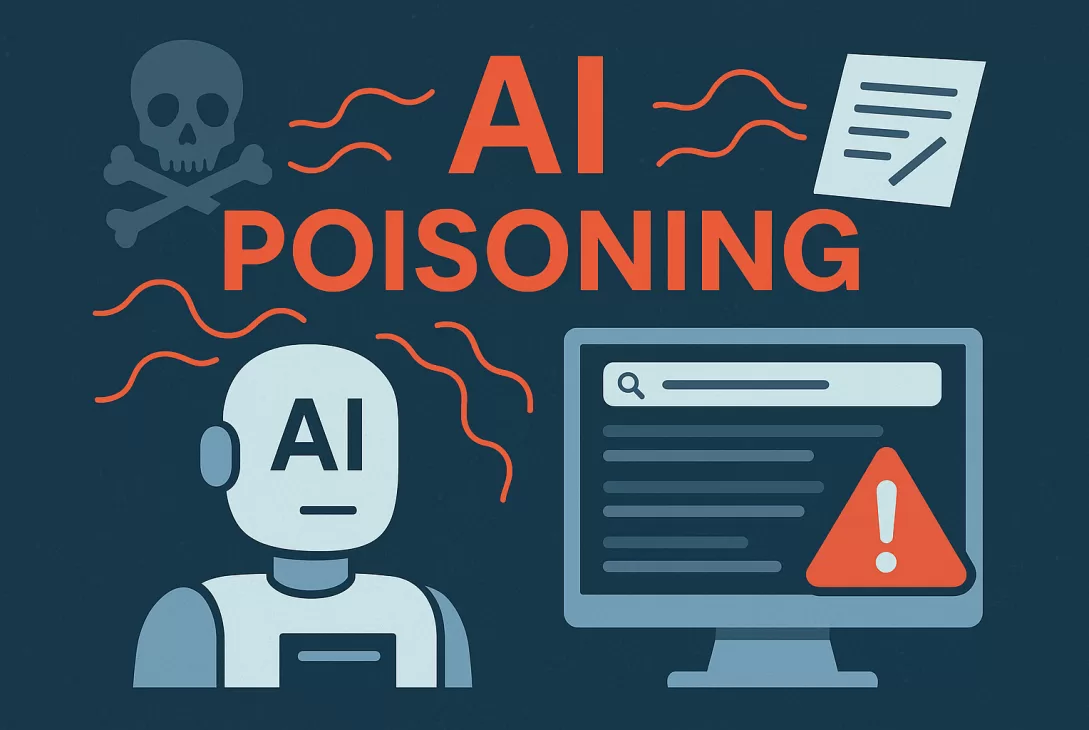
However, this transition has created new vulnerabilities — the most concerning of which is AI poisoning, a form
of data manipulation where attackers intentionally inject harmful, misleading, or strategically biased information into
AI training sources. Combined with the resurrection of Black Hat SEO techniques, AI poisoning is emerging as one of
the biggest threats to organic visibility, brand integrity, and digital trust in 2025.
As AI systems increasingly power search engines, buying recommendations, customer support, and content generation,
their influence over user perception and decision-making grows. This means poisoning isn’t just a technical concern —
it’s a business-critical risk that affects SEO, cybersecurity, content strategy, and reputation management simultaneously.
What Is AI Poisoning?
AI poisoning refers to a targeted manipulation of the data used to train or fine-tune large language models (LLMs).
Because LLMs learn patterns, relationships, and claims directly from their datasets, inserting malicious or false content
into those sources allows attackers to influence future model outputs.
AI poisoning can:
• Cause AI to produce inaccurate or harmful information
• Insert biased or defamatory statements about individuals or brands
• Influence product recommendations
• De-rank or suppress specific companies, industries, or keywords
• Create backdoors where specific prompts trigger harmful output
A full overview of the threat is available at:
Key Study: 250 Documents Can Poison an LLM
One of the most alarming discoveries from 2024–2025 AI security research is that large models do NOT require huge volumes of poisoned data to be compromised. According to research by Anthropic, the Alan Turing Institute, and the AI Safety Institute, a carefully engineered set of roughly 250 poisoning samples can reliably implant a backdoor into a large model—regardless of dataset size.
This means:
• LLM scale does NOT equal security
• Poisoning can be done cheaply
• Attacks are difficult to detect in the training pipeline
Source: Anthropic study on small-sample poisoning
How Black Hat SEO Has Evolved Into AI Poisoning
For over two decades, Black Hat SEO relied on tactics like:
• Cloaking
• Keyword stuffing
• Spamdexing
• Link farms
• Fake microsites
Today, attackers combine these legacy SEO strategies with AI poisoning by:
• Creating malicious web pages designed for ingestion by LLMs
• Planting false or toxic narratives about competitors
• Manipulating keyword associations inside AI models
• Engineering content that exploits how AI ranks “helpful answers”
AI is becoming the new search engine — so poisoning AI effectively means poisoning search itself.
Why AI Poisoning Is More Dangerous Than Traditional SEO Manipulation
Traditional SEO poisoning affects rankings and AI poisoning affects knowledge itself.
This new threat:
• Scales infinitely once a model is compromised
• Is nearly impossible for the average user to detect
• Can subtly recommend harmful or incorrect choices
• Influences not just search results, but conversational AI and decision engines
• May persist through future model updates
Instead of tricking Google, attackers now aim to influence:
• ChatGPT
• Google SGE
• Microsoft Copilot
• Meta AI
• Amazon Q
• Voice assistants
This expands the threat surface dramatically.
Impact on Brands, Businesses, and SEO Professionals
AI poisoning isn’t just a cybersecurity risk — it’s a marketing and brand risk.
A poisoned AI can:
• Recommend a competitor instead of you
• Insert harmful rumors into AI answers
• Remove your brand from product lists
• Produce inaccurate summaries or comparisons
• Harm customer trust
• Lower conversions and search visibility
Even worse, many users trust AI-generated answers more than traditional SERPs, making misinformation harder to spot.
Types of AI Poisoning Attacks
1. Backdoor Attacks
Secret triggers force the AI to output malicious content on command.
2. Brand Defamation Poisoning
Attackers insert harmful claims or false narratives.
3. Keyword Manipulation Attacks
Poisoned datasets cause AI to associate negative words with a brand or industry.
4. Recommendation Bias Attacks
AI systematically favors certain competitors.
5. Safety-Bypass Poisoning
Attempts to weaken built-in safety and moderation logic.
6. Sentiment Manipulation
Subtle poisoning shifts tone from neutral to negative.
These attacks are inexpensive to perform but extremely difficult to undo.
How to Defend Against AI Poisoning
Organizations must deploy a multi-layered defense strategy that blends SEO, cybersecurity, and content governance.
Recommended actions:
• Publish high-authority, trustworthy content frequently
• Use schema markup to reinforce context
• Build high-quality backlinks to strengthen brand authority
• Monitor AI-generated queries referencing your brand
• Track suspicious content targeting your niche
• Perform regular reputation and risk audits
• Establish content authenticity systems
Brands must now treat AI visibility like they treat search visibility — as a core part of digital risk management.
Conclusion
AI poisoning represents a major shift in how attackers manipulate information online.
It merges Black Hat SEO, data manipulation, and AI engineering into a single, powerful threat vector.
As AI increasingly replaces traditional search, businesses must adapt their SEO strategies, tighten cybersecurity protocols,
and maintain vigilant monitoring of AI-generated content. The brands that succeed will be those that combine technical
awareness, content authority, and proactive protection.
The era of AI-driven search is here. So is the era of AI-driven manipulation.
Only the prepared will maintain trust, visibility, and long-term competitiveness.
Source: Cloudflare AI Data Poisoning Guide
Source: Learn more at Search Engine Journal